
- Main
- Artists' works
- Temple of Sound
Natalia Diachok, Dmytro Matiukhin, Eugene Pylinsky, Andrii Moroz
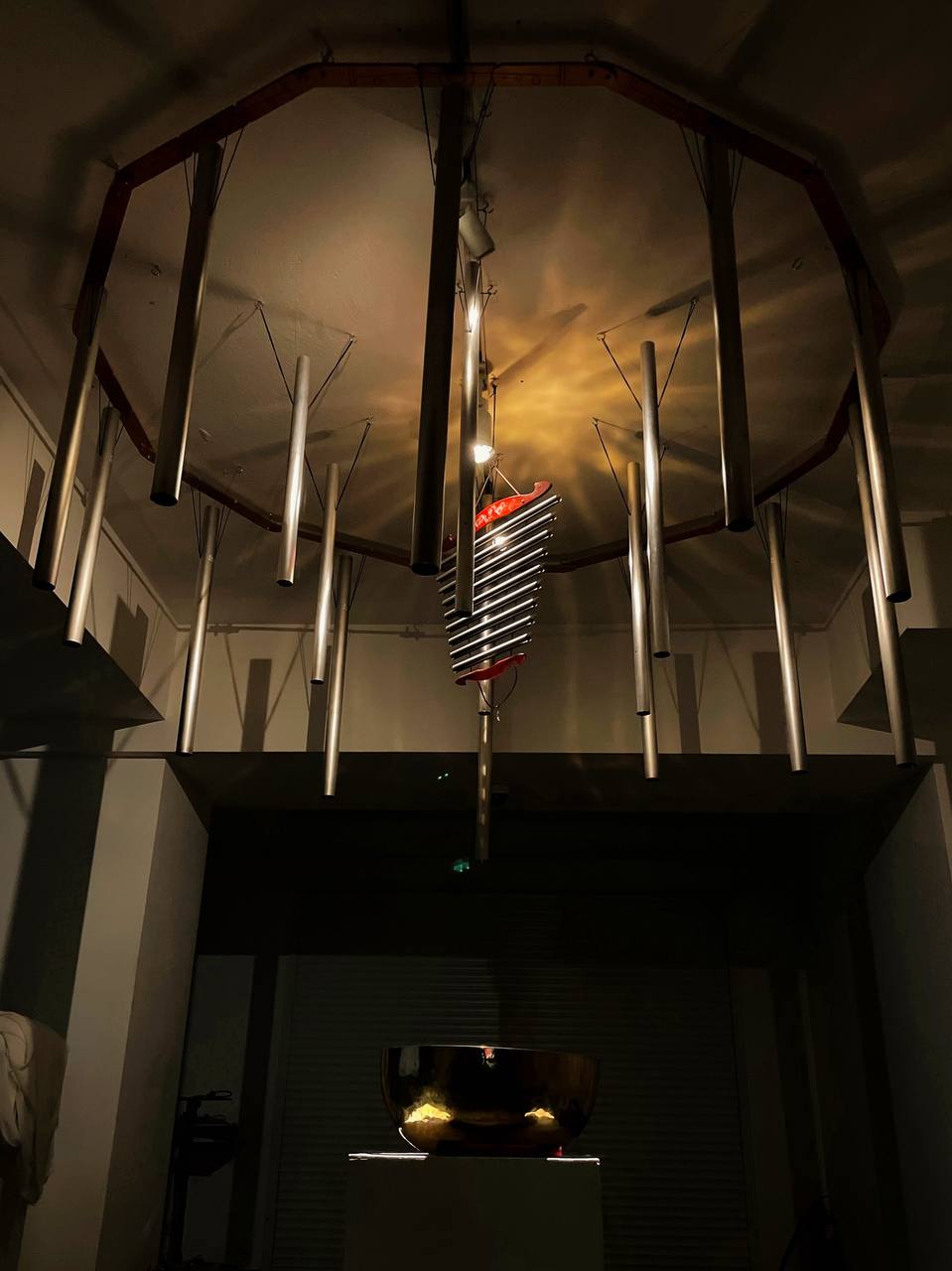
Through the sound and vibration of the instruments, you are invited to enter a personal space of restoration, calm, and inner balance.
Every sound here is intentional. The instruments are tuned so that, no matter how you interact with them, they produce harmonious tones. There is no wrong way to play them—only opportunities to explore, listen, and feel.
Sound has a profound effect on both the body and the emotions. Everything we hear and experience physically leaves its imprint. During wartime, many sounds have become associated with danger, tension, and fear.
We created the Temple of Sound as a place where everyone can experience a safe personal environment filled with harmony and tranquility—a space to pause, listen inward, and reconnect with a sense of inner stability.
When the body receives a steady and reassuring sonic signal, it gradually begins to attune itself to it, much like a musical instrument is tuned to a tuning fork. This process can help reduce stress, restore a sense of safety, and support the body’s natural capacity for recovery.
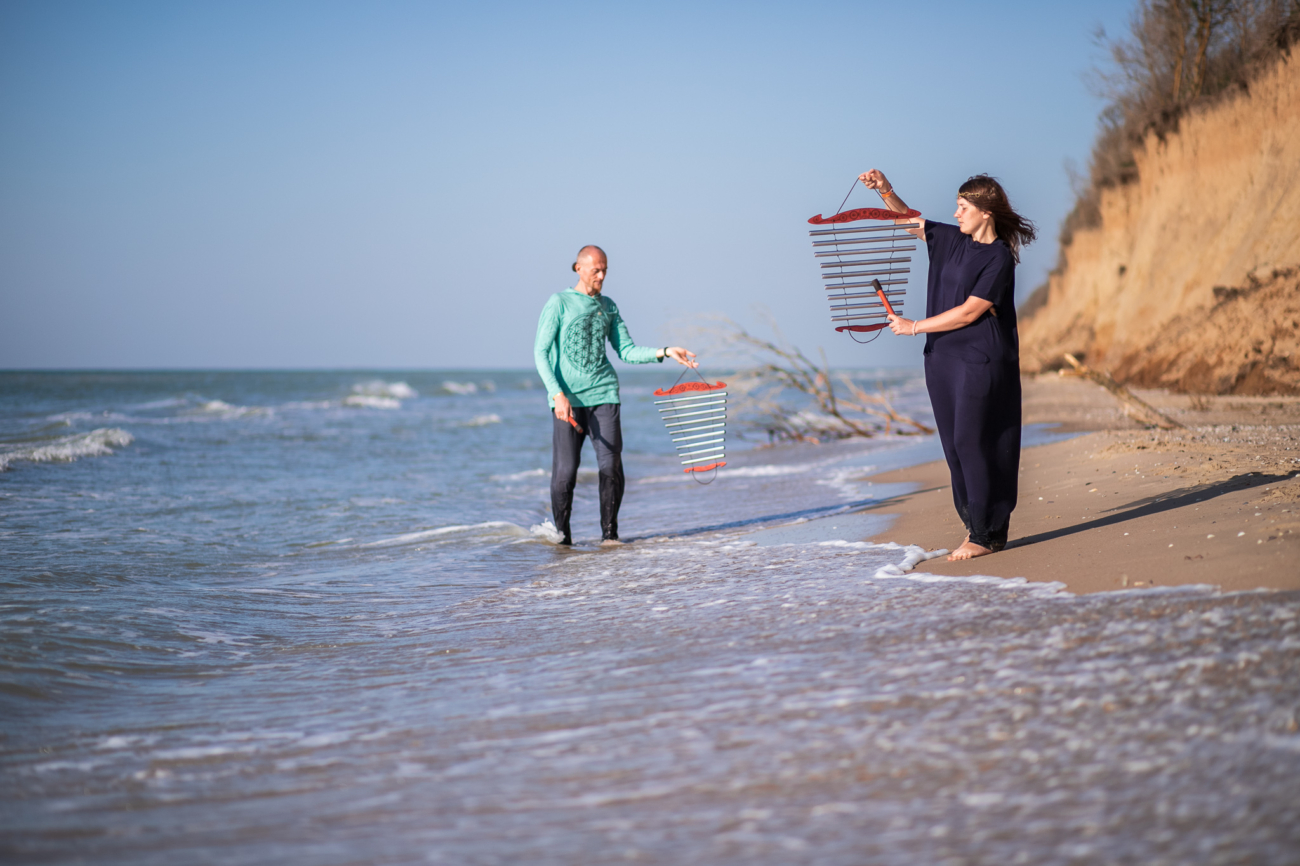
Dmytro Matiukhin is a Ukrainian artist, musician, instrument maker, and practitioner of sound-based practices. His professional work develops at the intersection of art, music, craftsmanship, and sound healing. His main areas of practice include creating acoustic instruments and sound objects, overtone singing, and exploring ways of interacting with sound.
Dmytro’s creative journey began with visual art and land art. His participation in numerous land art festivals and symposiums shaped his experience of working with materials, form, and space. It was during this period that an encounter took place which would later determine the direction of his professional practice.
In 2004, at the Sheshory Festival of Ethnic Music and Land Art, where Dmytro participated as a land artist, he saw and heard an Australian didgeridoo for the first time. He was fascinated by its unusual sound and the nature of its sound production. Several years later, in 2009, Dmytro began making didgeridoos himself. His artistic background, knowledge of materials, and experience with form became the foundation for mastering this new craft. This was the beginning of a workshop that gradually developed into one of the main areas of his professional activity.
Working with the didgeridoo led Dmytro to a deeper exploration of sound practices. He works with the didgeridoo, jaw harp, voice, throat singing, and overtone singing. Overtone singing holds a particularly important place in his practice. When Dmytro began exploring it, the practice was still largely unknown in Ukraine. He became one of the pioneers and active advocates of overtone singing in the country.
An important stage of this journey was his involvement in organizing and participating in musical and ethnocultural events. Dmytro was a co-organizer of the Kyiv Overtone Music Festival, curated sound programs at festivals, and participated in musical groups and projects. His communication with musicians from different traditions and representatives of the international sound healing movement broadened his understanding of the possibilities of sound — from a musical practice to a way of interacting with a person’s physical and emotional state.
Sound healing has become an important part of Dmytro’s practice. He combines work with voice, overtones, and acoustic instruments, using sound as a means of creating a particular state and a space for the listener.
Visit the artist’s Instagram page
In 2017, Dmytro and his wife, Natalia Diachok, founded the joint project Divya Svara. Natalia is the co-founder of Divya Svara, a sound healing and overtone singing practitioner. Their collaboration brought together the experience of instrument making with the practice of direct interaction with sound and the human being.
Within Divya Svara, they began creating Divya metallophones. Years of experience working with sound and materials allowed them to develop their own approach to instrument making. Divya metallophones combine precise tuning, distinctive tonal qualities, handcrafted production, and careful attention to visual form.
Divya metallophones have become one of the workshop’s main areas of activity and have gained recognition far beyond Ukraine. Dmytro and Natalia present their instruments at musical, artistic, and ethnocultural events, while continuing to develop their own sound practices.
Another area of Divya Svara’s work is the use of sound instruments and practices in programs focused on supporting and restoring human well-being. Dmytro and Natalia participate in rehabilitation programs, using sound as a tool for sensory, emotional, and embodied experience.
The next stage in the workshop’s development was the creation of Temple Bells, a series of tubular bells. Their sound and construction became the basis for further developing the idea of a sonic space — moving from an individual musical instrument toward an immersive environment.
This led to Temple of Sound, a collaborative sound installation by Dmytro and Natalia. Here, their many years of experience in instrument making, sound work, and sound healing practices are transformed into the space of an artistic object. The instruments are no longer merely sources of music but become part of the installation’s architecture. The viewer does not simply listen to the sound but enters the sonic environment and interacts with it through their own presence.
Visit the artist’s Instagram page
Audiovisual Component of the Installation
The audiovisual works created through the collaboration of Dmytro and Natalia with Andrii Moroz and Yevhen Pylynskyi continue the exploration of sound as a space for restoration and the search for harmony.
The musical component of the works was created using instruments from the Divya Svara workshop, as well as instruments made by Andrii Moroz in his own workshop. Yevhen Pylynskyi’s videos interact with the sound not as illustrations, but as independent visual spaces that help the viewer immerse themselves in the sound and transform their perception of time and the surrounding environment.
Each composition has its own character and creates a distinct emotional experience.
Golden Gate is a dreamy and luminous composition that creates a sense of lightness, warmth, and inner uplift. Integrated into the sonic texture of the work is the purring of Shanti the cat — an inseparable part of Dmytro and Natalia’s workshop. Shanti is regularly present during the sound practices that take place in the workshop and has become a kind of living part of this sonic environment. Her purring adds a sense of naturalness, intimacy, and safety to the composition.
Alchemy is a more immersive and meditative composition. Its sound is intended to slow down the inner dialogue, reduce the influence of external noise, and return attention to the body and its sensations. It creates a space for pause, concentration, and a deeper connection with oneself.
Visit the artist’s Instagram page
Andrii Moroz, known by his stage name PapaZvukov, is a Ukrainian percussionist, composer, inventor, and sound researcher. His practice is distinguished by a strong focus on sonic space and the search for new ways of shaping it. In his work, he combines acoustic instruments and electronics, creating complex soundscapes and paying particular attention to timbre, texture, and the most subtle nuances of sound.
Andrii created sound design for the Prana Breath and Magic Intuition applications.
His own projects include PapaZvukov, HlynoDzvin, Drum Station, and Mama Afrikana.
As a performer and studio musician, he has collaborated with Maria Burmaka, Ivanka Chervinska, The Maneken, Tarabarova, Gypsy Lyre, Janeuary, Irina Skazina, Vopli Vidopliassova, Ars Nova, Oleksandr Ponomariov, D.Lemma, Strelchenko Band, Revenko Band, Dmytro Krasnoukhov, Roman Hrynkiv, and other musicians.
Visit the artist’s Instagram page
Yevhen Pylynskyi is a 3D visual artist with more than 20 years of experience in animation and video design. In his work, he creates images and forms that exist at the intersection of abstraction, space, and movement.
His visual language helps translate the invisible nature of sound into the realm of imagery. The animation in the audiovisual component of Temple of Sound does not simply accompany the music but creates an independent perceptual space in which sound and image interact and complement one another.
In the collaboration between Dmytro and Natalia, Andrii Moroz, and Yevhen Pylynskyi, sound, visual imagery, and the living space of the installation come together as a single experience — a space where one can slow down, reconnect with oneself, and, for a while, set aside the noise of the outside world.