- Main
- Artists' works
- Entrance to the Magical World
Liza Obukhovska
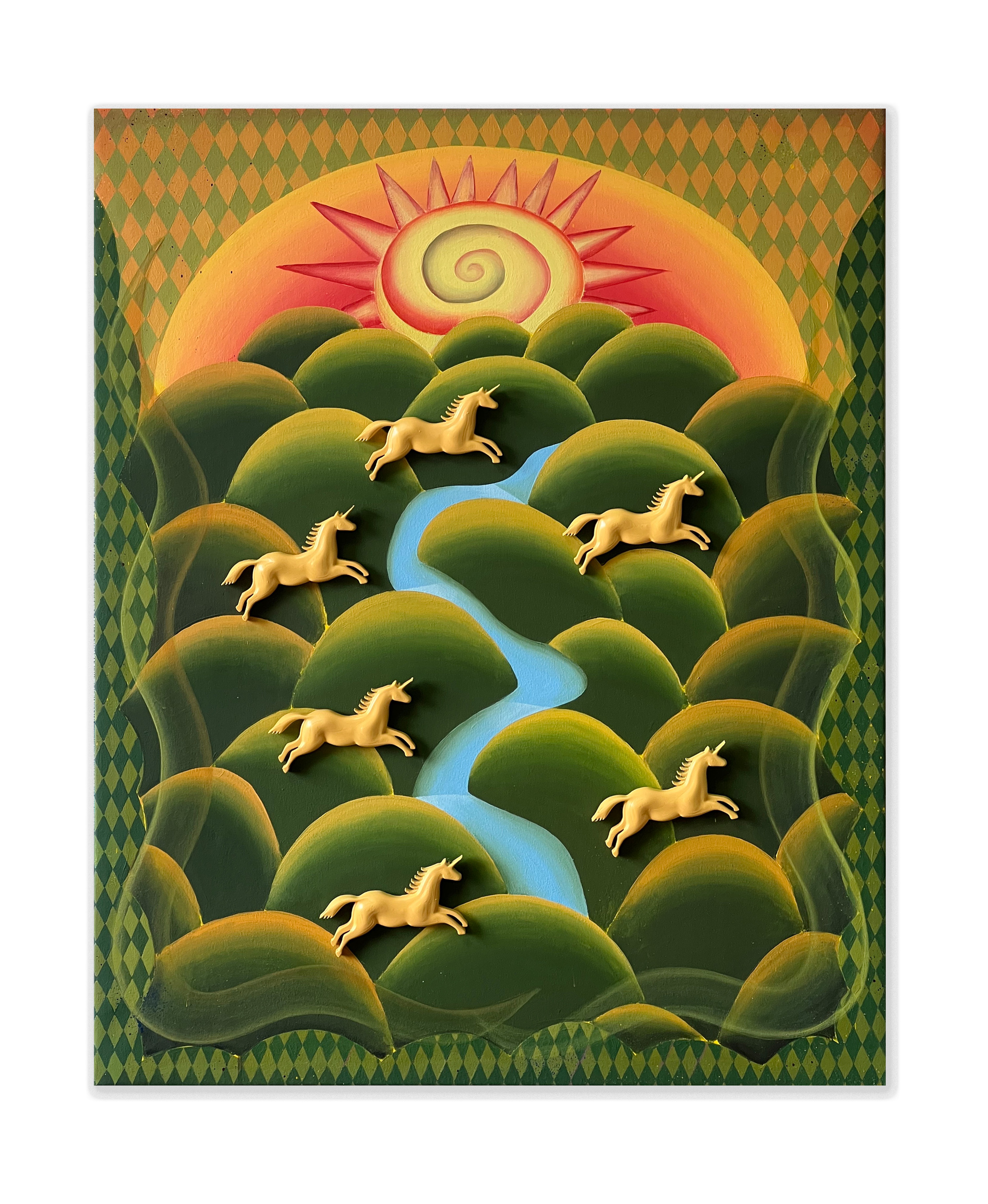
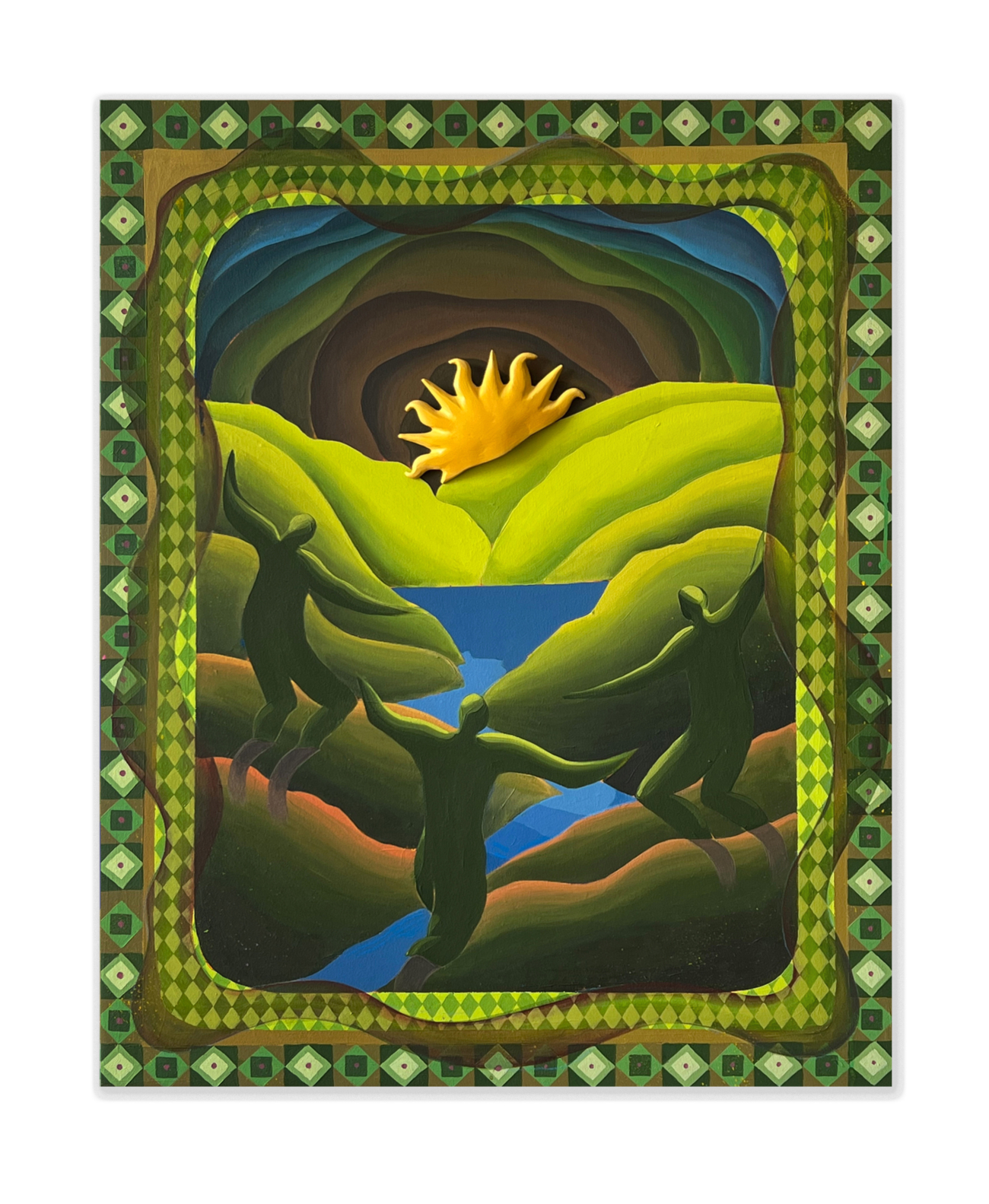
The project “When We Were Hills” turns to primordial, pagan notions of memory as a living and natural force transmitted not through texts or archives, but through the earth, landscape, myth, and embodied experience. The title of the project serves as a metaphor for a time when humans did not separate themselves from nature but perceived themselves as part of it — another form of terrain, another bearer of memory, much like hills or riverbeds.
The landscapes depicted in the works refer to the Podilian Tovtry (Khmelnytskyi region, the area I come from) — a space where the land itself functions as an archive preserving traces of many generations. The hills become an image of enduring memory: they change slowly, yet absorb history, myths, and spiritual beliefs. The earth appears here as a carrier of memory that exists beyond human chronologies.
In one of the works, unicorns appear — mythical creatures that, according to local legends, once inhabited these lands. They symbolize the sacred connection between humans, nature, and the imaginary realm, where myth is not fiction but a way of transmitting spiritual knowledge and collective experience.
Human figures in the paintings do not dominate the landscape; rather, they seem to merge with it, echoing its rhythms. This evokes a time when memory existed through shared actions, movement, and ritual. “When We Were Hills” also reflects the loss of this unity and, at the same time, the desire to rediscover it.
In the contemporary conditions of war, turning to collective memory becomes a source of strength that allows life to continue and renewal to occur. This memory cannot be physically destroyed, as it is dispersed — in people, in the land, in myths and images transmitted beyond official archives.
The paintings in the project function as portals — spaces for a temporary escape from tension and informational noise. They offer an opportunity to pause, to enter another rhythm, and to feel a connection with a deeper layer of reality. In this sense, art emerges both as a form of preserving memory and as a space for inner restoration.
Within the context of the exhibition “Cloud Archive”, the project “When We Were Hills” proposes an alternative understanding of heritage — one that cannot be fully “uploaded to the cloud,” because it lives in the earth, the body, myth, and shared experience.

Liza Obukhovska (b. 1996, Khmelnytskyi, Ukraine) is an artist working across painting, textile, and ceramics. In 2020, she graduated from the Lviv National Academy of Arts (Faculty of Decorative and Applied Arts, Department of Artistic Textiles).
Her series explore myths, land, and archetypal imagery, focusing on the inseparable connection between humans and nature, as well as the sense of belonging to one’s native place as a source of inner strength.
The artist’s works are held in private collections in the United Kingdom, Germany, and Ukraine, as well as in institutional collections, including the Museum of Contemporary Ukrainian Art of the Korsaks, Kirisenko Art Gallery, and the Khmelnytskyi Regional Art Museum.
She currently lives and works in Khmelnytskyi, Ukraine.