
- Main
- Artists' works
- Ich komme und sehe
German artists (participants of the "Assembly Scheme" project)

Anna Mirbach: The Poem she sent you already.
Nick Crowe:
Nick Crowe und Ian Rawlinson begannen mit der Arbeit an diesem Beitrag, als die Invasion in vollem Umfang begann. Wie viele Menschen außerhalb der Ukraine verfolgten sie den Krieg hauptsächlich über Telegram und andere Social-Media-Plattformen. Ausgangspunkt für ihre Arbeit ist das umfangreiche Videomaterial aus vielen Perspektiven, von Soldaten, Zivilisten, Medien usw. Sie bezeichnen das Stück, das sie gemacht haben, als eine Art “Kernprobe”, was natürlich ein Begriff ist, den sie der Geologie entlehnt haben. Für die Arbeit haben sie die Videos eines einzigen Telegram-Kanals verwendet, und sie sprechen davon, dass sie an einem Ort stehen und alles aufnehmen, was sie sehen. Dies ist die erste Präsentation dieser Arbeit, aber sie wird nächstes Jahr auch in London am 24. Februar gezeigt werden, um den zweiten Jahrestag der Invasion in vollem Umfang zu begehen.
Samuel Ellinghoven:
The shown works are ideas or experiments in the frame of the questions about how Ukrainians might imagine their future in the context of their Soviet past and the ongoing full-scale invasion by russia. With the choice of materials, I’m trying to implement the fragility and the unknown in that question.
My time in Kyiv, especially in the Institute of Automation, was packed with meeting super welcoming people who wanted to get to know me and my work. Which is so different from how people act in Germany. The feeling of being always welcome created a straight emotion of being home. It also helped me dive more into daily life in such horrible times where I saw people trying to make the best out of it and still not losing hope.
Leon Seidel:
The series “Imagined Cities” is an ongoing research work exploring sound and sound experience in context of the war against Ukraine. Inspired by the book “Sounds of War and Peace”, which focuses on the exploration of the soundscapes of European cities during the Second World War, Ukrainians from the cultural sector are interviewed in various cities about their acoustic experiences during the war. In an intimate setting, not only experience of sound but also very personal experiences of the war are being shared, thus expanding perspectives on the collectivity but also individuality of war experience. Three interviews of the series are being presented here at M17 Contemporary Art Center.
Eric & Norman:
Будівництво метро Київ-Берлін
Норман Берендт та Ерік Павліцький працюють над будівництвом лінії метро між Берліном та Києвом, яка також з’єднає інші міста вздовж маршруту. Берлінські митці представляють проекти вентиляційних шахт, аварійних виходів і планів маршрутів у вигляді скульптур і рельєфів. Звуки додають ще один вимір до роботи.
Sofie Schnellbach:
LAW OF THE INSTRUMENT
I recognise by the wetness: I have been inattentive, I have exhausted myself, I thought I was unobserved until the mishap spread. I want to appear controlled and yet I want to run riot, stand in a dark room and be seen from outside. However: in no time at all, oblivion can lead to a state of neglect, while at the same time coaxing out a liberated laugh from you.
Andreja:
“I do not call on you to use foul language. God forbid!” (2021, 13 min.), Andrėja Šaltytė and Leopold Tax Which language is allowed to be spoken in which rooms and who decides this? Where are you allowed to scold and where not? What is behind the swear language (what does the swear language hide) of the Slavic and post-Soviet space? Much used and heavily taboo, ranting attracts us as a field of linguistics and everyday life.
The short film “I do not call on you to use foul language. God forbid!” (2021, 13 min.) shows a rehearsal of a song composed by Olexyi Shmurak at our request and is based on two dictionaries: “Ukrainian Language without Taboo” (2008) by Lesya Stavitska and “Dictionary for Russian Mat [swear language]” (1997) by Tatyana Akhmetova. Swear language developed out of formely sacred pagan idioms, as they were forbiden by christian system.
Paul Maciejowski
Ein zentraler Idee des Projektes ist der Gedanke, den Austausch in die Ukraine hinein (und nicht aus der Ukraine hinaus) zu fördern und so zum Wachstum und Erhalt der Kyiver Kulturlandschaft beizusteuern, indem ein Netzwerk aus Freundschaften und gemeinsamen Initiativen ensteht. Soweit wir wissen ist „Ich komme und sehe“ in Kyiv derweil das einzige Projekt seiner Art und wir hoffen weitere Künstler*innen dazu zu motivieren, ähnliche Schritte zu gehen.
Art
“The sepia mother dies giving birth to her babies, generational knowledge is not passed on, just like them we are thrown into this world, waking up from the blackness”.
The dry point etching series, “When there´s a War the Whole World Suffers”, was started in 2016 with the ambition to create a personal surrealistic archive of the main events in the Russian – Ukrainian war.
It was created for a western audience, to transmit the feeling of awe and terror that I have researching the topic of war.
By listening to the stories told to me by friends that are fighting and the images I see in journalistic media, I try to find niche images that are ambivalent in their meaning, it is a multilayered approach often around subjects like the technology used in modern combat. I´m trying to create a symbolism based on this reality that is different than in foto or video.
(This) war is a madness that I still find hard to comprehend and in surrealism I try to express this, often the images hint at more general aspects of being human, extremified in the war world. Normal people enter into another reality and become something else. The images are stories from a reality where humans are throwing dynamite barrels at one another.
In August 2023 the PC Roleplaying game “Baldur´s Gate 3” was released, 815000 players fought against the so called “Mindflayers” online, in the same month the people working in the Ukrainian Army is about the same Number.
This is the crazy world we live in.
Sentences I´ve heard about war in Germany now: It´s banal, it´s illustrative, it´s human nature and will always be there, it´s so horrible that you may not speak of it.
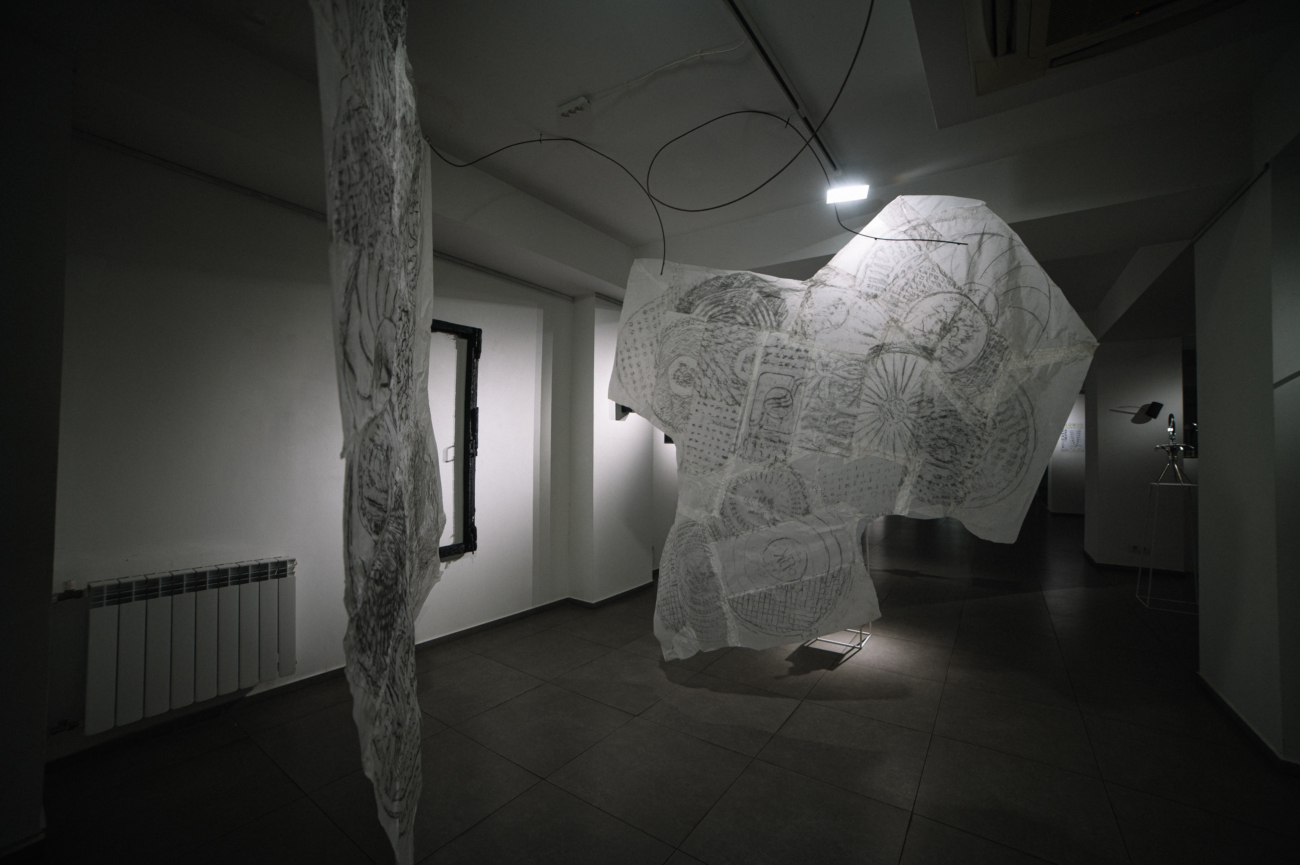
The works by artists from Berlin, Düsseldorf and Leipzig have been created at the Kyiv Institute of Automation since April 2023 during the “Ich komme und sehe” (I come and see) residency.
At the beginning of the full-scale invasion, many Ukrainian artists were forced to move their studios to the West. In return, Western artists were invited to come and work in Ukraine. The project of the residency at the Kyiv Institute of Automation was intended to provide an opportunity for artists from Germany to work in the space of the institute for one month, to interact with the Kyiv art scene, in particular with NAHIRNA22 artists, and to contribute to the development of the Kyiv art space.
Participants of the exhibition:
Norman Behrendt
Nick Crowe & Ian Rawlinson
Samuel Ellinghoven
Paul Maciejowski
Anna Mirbach
Eric Pawlitzky
Andrėja Šaltytė & Leopold Tax
Leon Seidel
Sofie Schnellbach
“There is no group concept to this exhibition, the uniting factor is that all the participating artists were willing and interested to work in Kyiv, in the reality of being at the edge of war. And tell their story of what they see, in their art.” – Paul Maciejowski, curator of the final exhibition of the residency of German artists “Ich komme und sehe” at the Kyiv Institute of Automation.
