
- Main
- Artists' works
- After Frida Kahlo “My birth”
Tymoshenko Anastasiia

For centuries, society has sought to control women—imposing upon them the obligation to give birth, to please, to perform roles defined not by themselves but by dominant structures: religious, state, and familial. Until quite recently, a woman could not exist outside the role of mother or wife—she had to conform to the “norm,” to create a “traditional” family in order not to be rejected by society.
Her body became a territory of discipline rather than freedom. Its reproductive function turned into an instrument of the capitalist machine—one that demanded new laboring bodies, new consumers, new soldiers.
Within such a system, individuality had no chance. It was either suppressed or survived in the form of inner resistance—as a secret dream of being someone else, free from the prescribed role. I think of those who had no choice—who lived lives that were not their own, simply because social codes allowed for no alternative. Of people who, in another reality, could have lived in harmony with their identities—beyond the confines of imposed roles and genders.
This painting is about a woman deprived of choice. About birth as violence. About a child that becomes a terrifying monster to the mother, killing life within her. About the silence in which generations learned to hide their desires in order to survive.
When I returned to Ukraine after years of studying in Italy, intending to stay, a conversation took place in my kitchen. Two Ukrainian art historians—whom I had considered intellectually mature and critically minded—were discussing the role of women in wartime. One of them said, and the other agreed: “The greatest contribution a woman can make to her country now is to give birth to a child.”
That dialogue struck me with nausea—and became one of the catalysts for my departure from Ukraine.
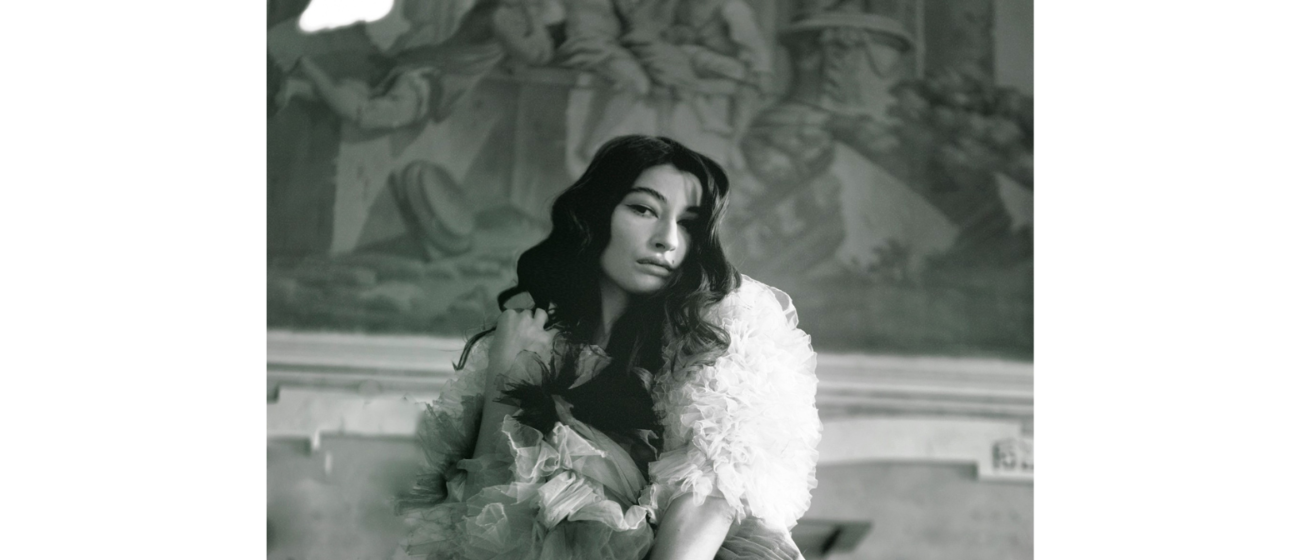
Born in the city of Lutsk on September 13, 1993, studied at the Boychuk Kyiv State Institute of Decorative and Applied Art and Design, the National Academy of Fine Arts and Architecture, and the Accademia di Belle Arti di Firenze. Since 2024, a member of artist groups KYD and LMDP (L’autre Moitié Du Paysage) created by Claire Roudenko-Bertin.
Her practice explores the entangled relationships between human bodies, nature, desire, and power. She is investigating how gender, witchcraft, heresy, and prostitution have been used to control and marginalize bodies — and how, despite that, these identities can carry subversive potential, complex histories of survival, and latent power.
“My work often returns to the forest — not as a romanticised escape, but as a primal, personal archive. As a child, I spent countless hours in my grandfather’s woods, playing with feathers instead of dolls, imagining myself as an animal. My earliest games were feral, sometimes erotic — intuitive rehearsals of transformation and transgression. It was in this same forest that I first menstruated. It was there that I understood the body as a threshold, a site of mystery and revolt.
Monstrosity, for me, is a form of truth. It is not deformity, but defiance — a refusal to be sanitized or assimilated. I embrace monstrosity as authenticity, as a form of noncompliance with systems that demand purity, submission, or legibility.
I am also drawn to imperfection — to what is socially rejected, non-normative, or “unacceptable.” For me, imperfection is political, It’s a statement. It resists fascism, classism, and every structure that enforces idealized bodies, behaviors, and aesthetics. I see the unwanted and the unruly as a form of political resistance — a living critique of systems built on exclusion.
My work moves through painting, sculpture, performance, video, and ritual to recover voices of the silenced: the witch, the whore, the beast, the heretic. I reclaim these figures not as metaphors, but as real presences — erotic, political, and alive.”