
- Main
- Artists' works
- Heavenly Altar
Natalia Satsyk

“Heavenly Altar” is an exploration of collective memory in the context of war through a sacred form, historically intended to preserve presence rather than information.
At the heart of the project is an authentic early 20th-century kivót — a liturgical object traditionally kept on the altar, designed for bodily interaction: approaching, touching, kissing. This gesture is fundamentally important, as sacred memory has always been tied to the body and ritual, not to distant observation.
Inside the kivót are small icons — wooden panels measuring 2.5 × 2.5 cm with images of angels resembling a pixelated form. These angels have no individualized features. They are multiple, small, dispersed, yet equal in value. This structure rejects the hierarchy of a single center and instead proposes an image of distributed sacred presence — a memory that is not stored in one place and cannot be physically destroyed.
The project does not attempt to answer the question “Who is holy today?” Instead, it investigates how, in contemporary conditions of war, the image of holiness is formed, how collective memory imbues sacrifice with meaning, and whether we can truly comprehend its scale when we see a person only in a fragmented, pixelated form.
In the context of the digitalization of memory, Heavenly Altar contrasts archives and cloud storage with an experience that cannot be fully digitized. This is a memory that requires physical presence, pause, and a shift in perspective. To see these images, the viewer must approach — literally and metaphorically.
Thus, the project emphasizes both the fragility and resilience of collective memory, which exists not in data, but in the living act of co-presence.
Heavenly Altar is an attempt to restore the sacred to its original function: to serve as a place of encounter with that which cannot be reduced to information, yet cannot be lost.
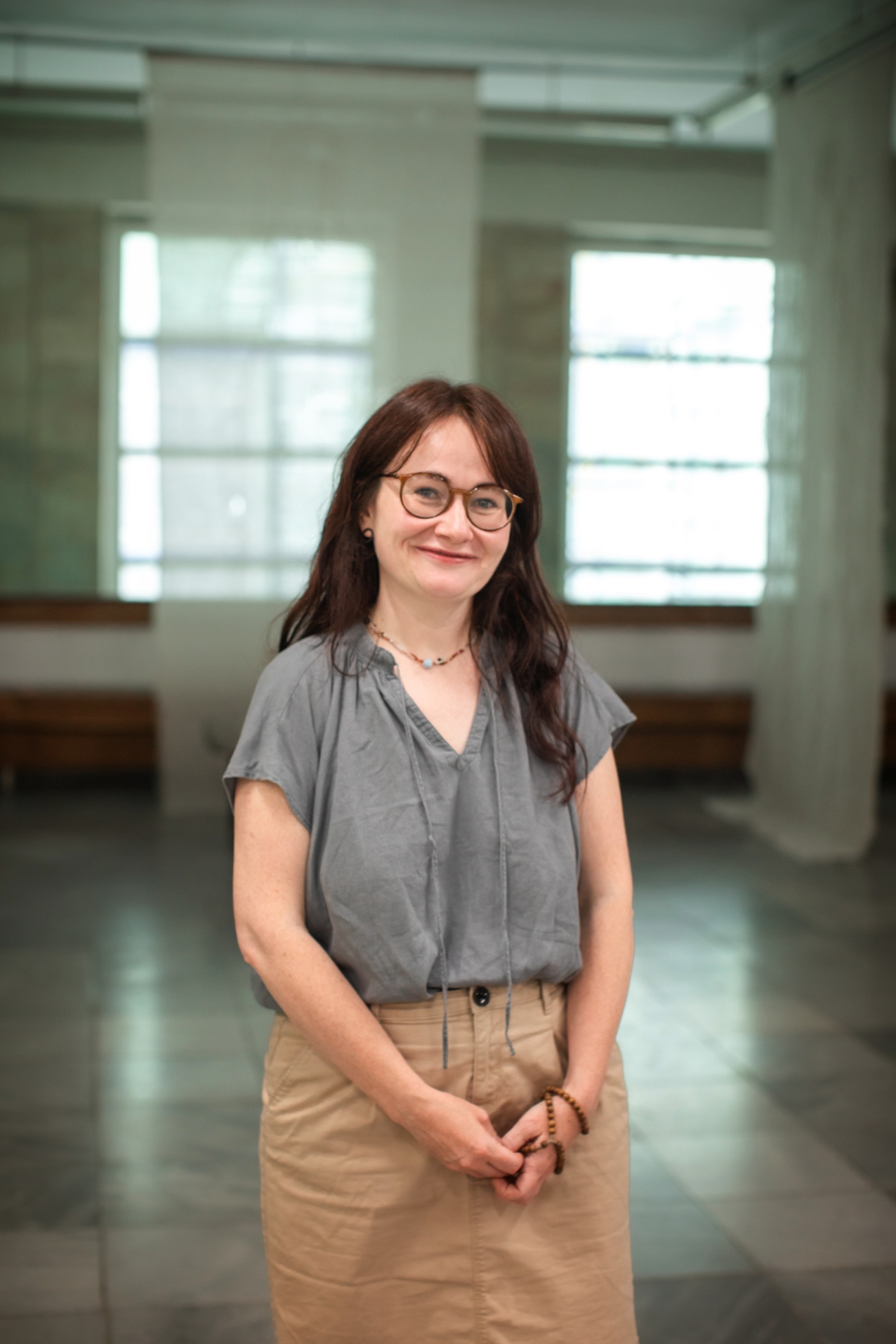
I am Natalia Satsyk a Ukrainian artist working at the intersection of sacred art, contemporary expression, and visual theology. My roots lie in the Eastern Christian tradition, where the church is a total work of art and the liturgy is a mystical performance uniting music, architecture, iconography, and word.
I explore themes of light, the invisible presence of God, angels, and reinterpret long-established iconographic subjects with a renewed mystical vision. For me, the sacred is the space where all answers reside — and it is this space I seek to translate into my works.
In my artistic practice, I merge experimentation with tradition: from the techniques of the old masters — egg tempera on wood, mineral pigments, and gold leaf — to contemporary practices such as textiles, glass, relief abstractions, printmaking, and encaustics. My art balances between canon and personal experience; it is prayer and challenge.
“My mission is to find a contemporary language for sacred art that speaks to people today.”